Our First Grade 4 Agility Show Wasn’t Successful on Paper. But It Was One of Our Biggest Wins Yet!
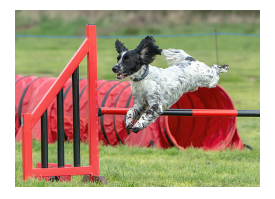
Yesterday, me and Quest stepped into our first Grade 4 show. Now, if you looked purely at the results on paper, you’d probably think it was a bit of a disaster.
Three E’s.
Mistakes.
Chaos.
Courses that looked like car crashes at times.
But honestly?
It was one of the best agility days we’ve ever had.
Not because we won anything.
Not because we got clear rounds.
Not because everything went perfectly.
But because for the first time ever, I genuinely enjoyed every single moment of competing with Quest.
And if you know our journey, that is massive.
Living and Training With a Sensitive Dog
Quest is a dog who massively picks up on my emotions.
If I’m slightly underconfident, anxious, worried, frustrated, or carrying pressure, it shows up almost instantly in his behaviour.
He’s not a dog that lets me get away with anything. Alongside his own confidence struggles and anxiety, I’ve had to do a huge amount of work on myself too.
Not just agility skills.
Not just handling.
But my mindset, emotional regulation, confidence, expectations, and ability to stay flexible under pressure. Being neurodivergent obviously factors into this too.
Because with dogs like Quest, your emotional state matters…..A lot!
That’s one of the reasons I created my From Anxious to Amazing framework in the first place. Because I realised very quickly that this journey was never just about obstacles.
It was about understanding the full picture.
Going Into Grade 4 With Realistic Expectations
I think one of the biggest mistakes people make in agility is going into competitions with unrealistic expectations. There are so many little pieces that need to come together for a successful performance.
It isn’t just:
“Can the dog do the skills?”
Success in agility is the result of multiple moving pieces aligning at the same time.
That’s why I always talk about agility as a jigsaw.
The dog has their own jigsaw…..
That includes things like:
- Confidence
- Arousal levels
- Emotional state
- Motivation
- Reinforcement history
- Agility skills
- Environmental sensitivity
- Forward drive
- Recovery skills
- Understanding of sequences
Then the handler has their own jigsaw.
This jigsaw includes things such as:
- Handling skills
- Timing
- Verbals
- Confidence
- Anxiety
- Pressure
- Expectations
- Ego
- Emotional regulation
- Mindset
And then both of those jigsaws have to fit together.
The glue that holds them together is the relationship / partnership.
And not a weak little Pritt Stick relationship that falls apart the second things wobble. It needs to be superglue.
Because the reality is that emotional states fluctuate constantly.
Not just day to day.
Run to run.
Moment to moment!!
Your dog might feel completely different by the third run compared to the first.
You might feel different too.
A comment from somebody outside the ring can throw you.
Another dog getting too close can spike your dog’s arousal.
A difficult sequence can create pressure.
One mistake can shift confidence.
People often look at performance as something static.
But it isn’t. Performance is fluid.
Why I Didn’t Care About the Results
Going into Grade 4, I already knew we were stepping into a very different level of course design.
Quest has done a huge amount of forward drive work because confidence building has been such a big part of our journey.
So while I knew he had developed massively, I also knew we hadn’t spent lots of time training the type of discriminations and challenge points that often appear in Grade 4 and 5 courses.
I wasn’t naive about that. I didn’t go there expecting clear rounds.
I went there to observe.
To gather information.
To see what held up under pressure.
To see what skills surprised me.
To see what we needed to go away and train.
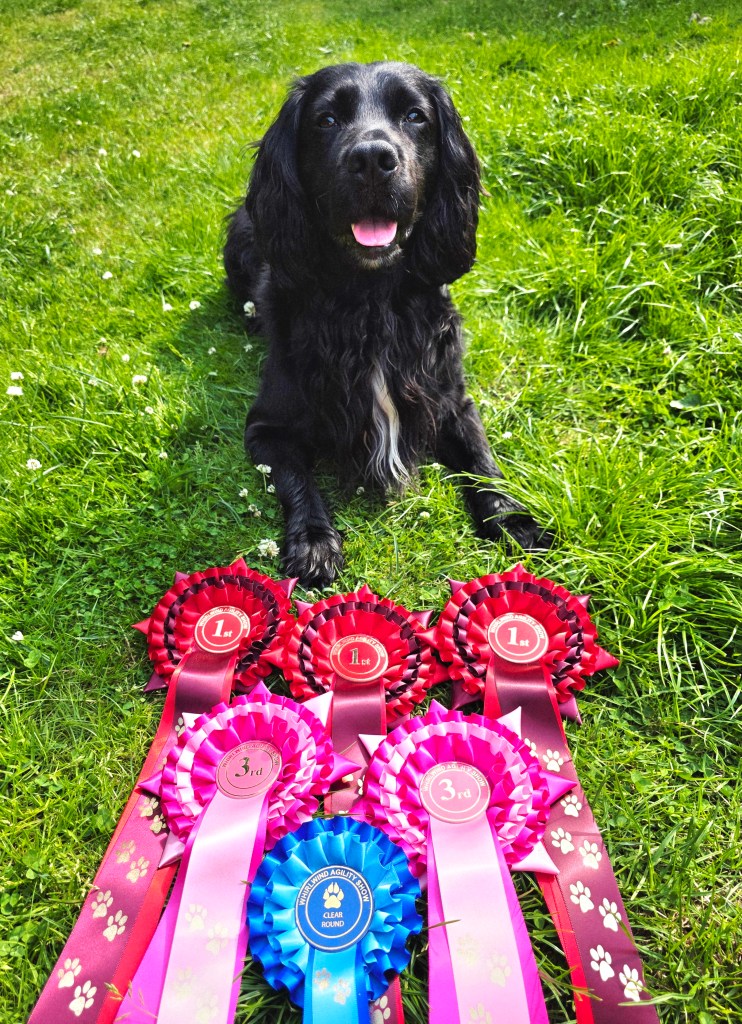
I wasn’t chasing rosettes. I was chasing understanding.
And honestly, that mindset changed everything.
The First Run Was Absolute Chaos
Our first run was agility. Usually Quest gets a jumping run first, so the different order immediately changed the picture emotionally.
His arousal was sky high. If you watched the run, it looked wild.
He flew his seesaw.
He drove onto the wrong equipment.
He made multiple mistakes.
But here’s the important part.
I knew it wasn’t a skills issue.
As an agility behaviour specialist, I understand the difference between a dog who doesn’t know how to do something and a dog who temporarily cannot access the skill because of emotional state and arousal.
That distinction matters….A huge amount!!!.
Because many handlers immediately assume:
“We need to retrain the obstacle.”
But actually, the issue is often emotional rather than technical.
And Quest proved that in his second agility run.
Because he didn’t fly the seesaw the second time.
Same dog.
Same obstacle.
Different emotional state.
Different outcome.
That’s not lack of understanding.
That’s arousal affecting performance.
Why I Don’t Reset Quest Mid-Run
Another thing I know about Quest is that repeated resetting damages his confidence.
So while some handlers may choose to stop and reset multiple times during errors, I know that for him, maintaining flow and emotional safety matters more.
That’s not me ignoring mistakes.
That’s me understanding the dog in front of me. Because agility isn’t one-size-fits-all.
What helps one dog emotionally can completely unravel another. And I think that’s something we don’t talk about enough in dog sports.
The Run That Told Me Everything
Our final run was jumping.
And honestly?
When I walked the course, I already knew exactly where we’d struggle. There was a discrimination challenge where Quest needed to take a jump instead of driving straight into a tunnel.
We haven’t trained enough of those skills yet. So I already knew what he was most likely going to do.
And he did exactly that. Straight into the tunnel.
But instead of feeling frustrated, disheartened, or embarrassed, I actually found myself excited. Because now I knew exactly what we needed to go away and work on.
That’s the part I think people miss.
Competitions don’t just exist to prove what you can already do. They can also highlight what you need to develop.
And that’s valuable.
The Biggest Win Had Nothing To Do With Agility Skills
The biggest thing I noticed wasn’t actually about the runs.
It was about Quest emotionally. When Quest first started competing, the pressure of the environment was so overwhelming for him that he would toilet in the ring.
It didn’t matter how much I toileted him beforehand.
The emotional pressure was simply too much.
That’s one of the reasons I avoided competing him at Dog Sports Derby shows for years.
Over time, that shifted. Instead of toileting in the ring, he would usually toilet between runs as a way of processing the stress.
But yesterday?
He didn’t do that once. And to most people, that probably sounds insignificant.
To me, it’s huge.
Because it tells me his emotional resilience in that environment has grown massively.
That’s progress.
Not visible progress.
Not flashy progress.
But real progress.
The Moment That Really Showed Me How Far We’ve Come
Quest usually enters the ring off lead.
He waits. Then I call him through with me.
On his first two runs, he could do that.
On the third run, he froze. And years ago, that moment would have spiralled me emotionally.
I would have panicked.
Worried.
Felt embarrassed.
Started overthinking.
But this time? I simply adapted.
I went back to him.
Cued him to jump into my arms.
Gave him reassurance.
Reset him emotionally.
Then popped him back down and carried on.
Because I always have backup plans. And I think flexibility is one of the most underrated skills in agility.
Rigid handlers struggle when things don’t go to plan. But dogs aren’t robots.
Their emotional needs fluctuate.
Their confidence fluctuates.
Their arousal fluctuates.
And our job is to learn how to support the dog in front of us. Not force them into a picture they can’t currently cope with.
The Biggest Change Was Actually In Me
Driving home, I realised something.
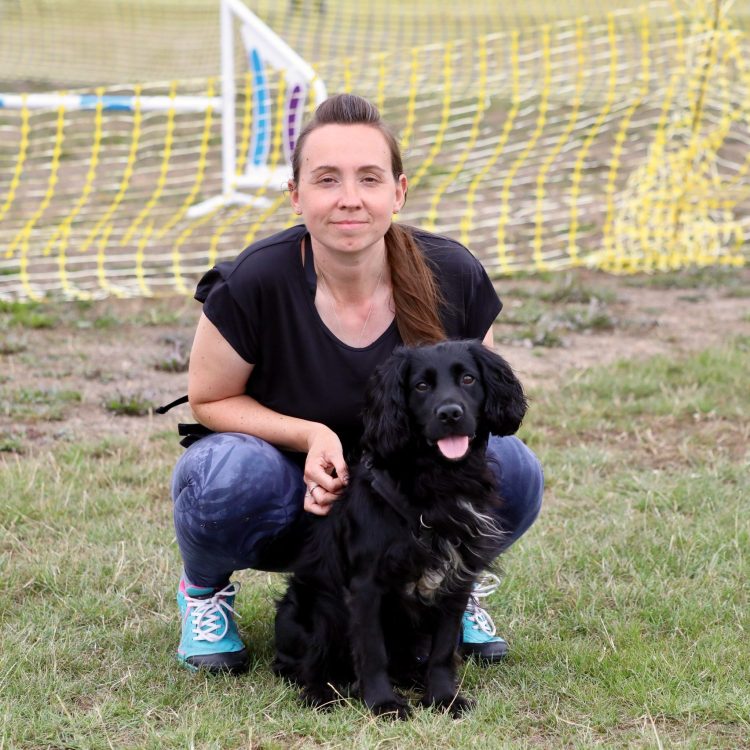
This was the first competition I have ever done with Quest where I genuinely enjoyed every second of the day.
Not just parts of it.
The whole thing.
I enjoyed walking the courses.
I enjoyed analysing the challenges.
I enjoyed seeing where we needed to improve.
I enjoyed chatting to people.
I enjoyed watching others succeed.
There was no comparison.
No feeling that we were behind.
No resentment.
No pressure.
No panic.
Just curiosity. And honestly, that felt freeing. Because agility culture can become incredibly outcome-focused.
People become fixated on:
- Clear rounds
- Winning
- Moving up grades
- What went wrong
- What the dog “should” have done
- Comparing themselves to everyone else around the ring
And somewhere along the way, people forget that agility is actually supposed to be fun!!
But Quest has taught me something really important. Success isn’t just about the result on paper.
Sometimes success looks like:
- A dog entering the ring happily
- A dog recovering emotionally after mistakes
- A dog showing resilience
- A handler staying calm
- Adapting instead of panicking
- Feeling connected as a team
- Leaving inspired instead of defeated
And honestly?
Those things matter far more to me now.
Why I Don’t Care How Long It Takes Us To Win Up
I genuinely do not care how long it takes us to progress through the grades. Because Quest has one life with me.
My job is to make sure that life feels safe, enjoyable, fulfilling, and fair. Agility is a bonus.
And ironically, I actually think this mindset creates better long-term performance anyway.
Because when you stop obsessing over outcomes and start focusing on understanding your dog, building the relationship, developing the skills, and supporting emotional wellbeing, success often follows naturally as a byproduct.
Not because you forced it.
But because all the little pieces of the jigsaw finally start fitting together.
Final Thoughts
If you’re struggling with competition nerves, confidence issues, comparison, frustration, or a sensitive dog who seems to mirror every emotion you feel, please know this:
Progress is not always visible on paper. And sometimes the most successful days are the ones where you leave feeling inspired instead of defeated.
Yesterday, Quest came away happy.
And for the first time ever, so did I.
That feels far more important than any clear round!!
Want Support With Your Own Anxious or Sensitive Dog?
A lot of what I’ve talked about in this blog forms part of my From Anxious to Amazing programme.
This is an 8-week coaching programme designed to help handlers better understand:
- Emotional regulation in dog sports
- Confidence building
- Arousal and behaviour
- Handler mindset
- Pressure and expectations
- Relationship-centred training
- Creating adaptable strategies for real-life competition environments
The framework is based on the work I’ve done with Quest, alongside the many handlers and dogs I’ve supported over the years.
The next programme starts on the 13th of May.
If you’d like more information or want to join us, click here.
You do not have to navigate this journey alone.
Katrina xx